Children’s Word Learning and Effects of Context Variability
My research examines how children learn new words across repeated interactions, with a particular focus on how contextual recurrence and variability shape retention and generalization. Besides investigating children’s interactions with humans, I use social robots as a controlled methodological tool to systematically vary interactional conditions. Additionally, this work approaches word learning as a gradual, interactional, and goal-oriented process situated within a particular pragmatic context, rather than as a one-shot mapping process. In this process, children build meanings across interactions and partners. This includes asking which aspects of the context benefit learning, which promote flexible transfer, and how changing interaction partners affects children’s retrieval of learned words.
Key aspects of investigation include:
Children’s word learning over time: how children encode, retain, retrieve, and generalize new words across repeated learning and testing episodes.
Children’s sensitivity to context variability: how changes in interaction partner, situational conditions, and prior experience influence children’s recall, transfer, and stability of lexical knowledge.
Interactional structure of learning contexts: how repeated versus varied pragmatic frames and contextual configurations influence learning.
Robots as a methodological tool: how social robots can be used to control and vary interactional conditions to study the effects of contextual recurrence and variability on word learning.
Related publications
Tolksdorf, N. F. (2024). Wortlernen mit sozialen Robotern: Der Einfluss einer systematischen Variation des pragmatischen Rahmens auf das langfristige Lernen morphologisch komplexer Wörter von Vorschulkindern (1. Auflage). Narr Francke Attempto. https://www.narr.de/wortlernen-mit-sozialen-robotern-1145-1/
Tolksdorf, N. F., Hönemann, D., Viertel, F. E., & Rohlfing, K. J. (2022). Who is that?! Does changing the robot as a learning companion impact preschoolers’language learning? Proceedings of the 2022 ACM/IEEE International Conference on Human-Robot Interaction, 1069–1074. https://doi.org/10.5555/3523760.3523937
Ethics in Child–Robot Interaction
This line of research investigates the ethical dimensions of child–robot interaction. It focuses on the interplay between technology and interaction design, children’s developmental characteristics, the perspectives of stakeholders, and educational institutional environments – social contexts in which the application of social robots is considered.
Key aspects of investigation include:
Children’s perspectives and participation: how children’s developmental vulnerability may influence their participation in interaction with the technology.
Institutional context: how child–robot interaction fits into pedagogical routines, caregiver roles, stakeholder expectations, and the broader social norms of educational settings.
Interaction design and ethics: how transparency, multimodal behavior (e.g., speech design), caregiver involvement, and data-related issues affect the responsible integration of robots into children’s everyday learning environments.
Related publications
Rohlfing, K. J., Altvater-Mackensen, N., Caruana, N., van den Berghe, R., Bruno, B., Tolksdorf, N. F., & Hanulíková, A. (2022). Social/dialogical roles of social robots in supporting children’s learning of language and literacy—A review and analysis of innovative roles. Frontiers in Robotics and AI, 9(971749), 1–15. https://doi.org/10.3389/frobt.2022.971749
Tolksdorf, N. F., Siebert, S., Zorn, I., Horwath, I., & Rohlfing, K. J. (2021). Ethical considerations of applying robots in kindergarten settings: Towards an approach from a macroperspective. International Journal of Social Robotics, 1–12. https://doi.org/10.1007/s12369-020-00622-3
Tolksdorf, N. F., & Rohlfing, K. J. (2020). Parents’ views on using social robots for language learning. 2020 29th IEEE International Conference on Robot and Human Interactive Communication (RO-MAN), 634–640. https://doi.org/10.1109/RO-MAN47096.2020.9223540
Siebert, S., Tolksdorf, N. F., Rohlfing, K. J., & Zorn, I. (2019). Raising robotic natives?: Persuasive potentials of social robots in early education. The Journal of Communication and Media Studies, 4(4), 21–35. https://doi.org/10.18848/2470-9247/CGP/v04i04/21-35
For more information, take a look at a flash talk I gave at “DigitaleZukunft@OWL.” Congress to facilitate knowledge transfer with civil society actors. The talk focused on the potential of social robots in early childhood education. A recording of the event is available, including my talk, which starts at the 3:37:18.
Children’s Multimodal Behavior in Interaction
My research investigates how children coordinate speech, gesture, gaze, timing, and other signals in interaction. Rather than treating communication as primarily verbal, this work examines multimodal behavior as a central mechanism through which children manage turn-taking, respond to contingency patterns, and adapt to different social partners and contexts.
Key aspects of investigation include:
Children’s multimodal turn-taking: how children use speech, gesture, gaze, delay markers, and timing to take turns to coordinate interaction.
Adaptation to different partners and settings: how children adjust their communicative behavior across partners, situations, and repeated encounters.
Responsive technology and robot design: how technologies such as social robots need to perceive and respond to children’s multimodal signals in order to support contingent, child-centered interaction.
Individual variation in interaction: how variability in children influences interaction and should inform adaptive technology design.
Related publications
Tolksdorf, N. F., Crawshaw, C. E., & Rohlfing, K. J. (2021). Comparing the effects of a different social partner (social robot vs. Human) on children’s social referencing in interaction. Frontiers in Education, 5(569615), 1–12. https://doi.org/10.3389/feduc.2020.569615
Tolksdorf, N. F., & Mertens, U. (2020). Beyond words: Children’s multimodal responses during word learning with a robot. In K. J. Rohlfing & C. Müller-Brauers (Eds.), International perspectives on digital media and early literacy: The impact of digital devices on learning, language acquisition and social interaction (pp. 90–102). Routledge. https://www.taylorfrancis.com/chapters/beyond-words-nils-tolksdorf-ulrich-mertens/e/10.4324/9780429321399-7
Tykhonenko, V., Tolksdorf, N. F., & Rohlfing, K. J. (2024). How turn-timing can inform about becoming familiar with a task and its changes: A study of shy and less shy four-year-old children. Proceedings of the Annual Meeting of the Cognitive Science Society, 46, 5904–5911. https://escholarship.org/uc/item/26b984sz#main
Children’s Interactions, Learning, and Criticality with Embodied AI and Social Robots
This work examines how children interact with embodied AI and social robots as learning and conversational partners. The focus is on dialogue design and variability in children’s interactions with such technologies. Across studies, I investigate how children can improve their language abilities with social robots and how they engage with them in social interactions, exploring how they approach them as social partners in developmentally meaningful ways, considering this in comparison to human–human interactions.
Key aspects of investigation include:
Language learning: how children acquire and retrieve productive and receptive vocabulary, and how they engage in metalinguistic and metacommunicative reflection.
Individual differences and multimodal adaptation: how children’s characteristics shape their interaction and learning, as reflected in gesture, gaze, turn timing, and other communicative behaviors.
Social dynamics during interaction with technology: how can children harness the potential of social robots in triadic and polyadic settings involving peers or caregivers.
Interaction and dialogue design: how robots and digital systems may structure interaction, feedback, timing, and communicative contingencies to support developmentally appropriate learning processes.
Criticality: how children become aware of the communicative and technological properties of embodied AI, and how interaction with such systems may elicit reflection relevant to early digital literacy.
Related publications
Hanulíková, A., Tolksdorf, N. F., & Kapp, S. (2026). Robot speech: How variability matters for child–robot interactions. Frontiers in Robotics and AI, 12, 1725423. https://doi.org/10.3389/frobt.2025.1725423
Rohlfing, K. J., Wildt, E., & Tolksdorf, N. F. (2024). Language learning with media and technology in (early) childhood. Dzieciństwo. Literatura i Kultura, 6(1), 35–69. https://doi.org/10.32798/dlk.1376
Tolksdorf, N. F. (2024). Wortlernen mit sozialen Robotern: Der Einfluss einer systematischen Variation des pragmatischen Rahmens auf das langfristige Lernen morphologisch komplexer Wörter von Vorschulkindern (1. Auflage). Narr Francke Attempto. https://www.narr.de/wortlernen-mit-sozialen-robotern-1145-1/
Tolksdorf, N. F., Viertel, F. E., & Rohlfing, K. J. (2021). Do shy preschoolers interact differently when learning language with a social robot? An analysis of interactional behavior and word learning. Frontiers in Robotics and AI, 8(676123), 1–14. https://doi.org/10.3389/frobt.2021.676123
Below you can find a video (in German) that was realised in cooperation with the Heinz Nixdorf MuseumsForum and shows part of our work on using social robots in the area of language learning.
Temperament, Shyness and Children’s Communicative Adaptation to varying Social Situations
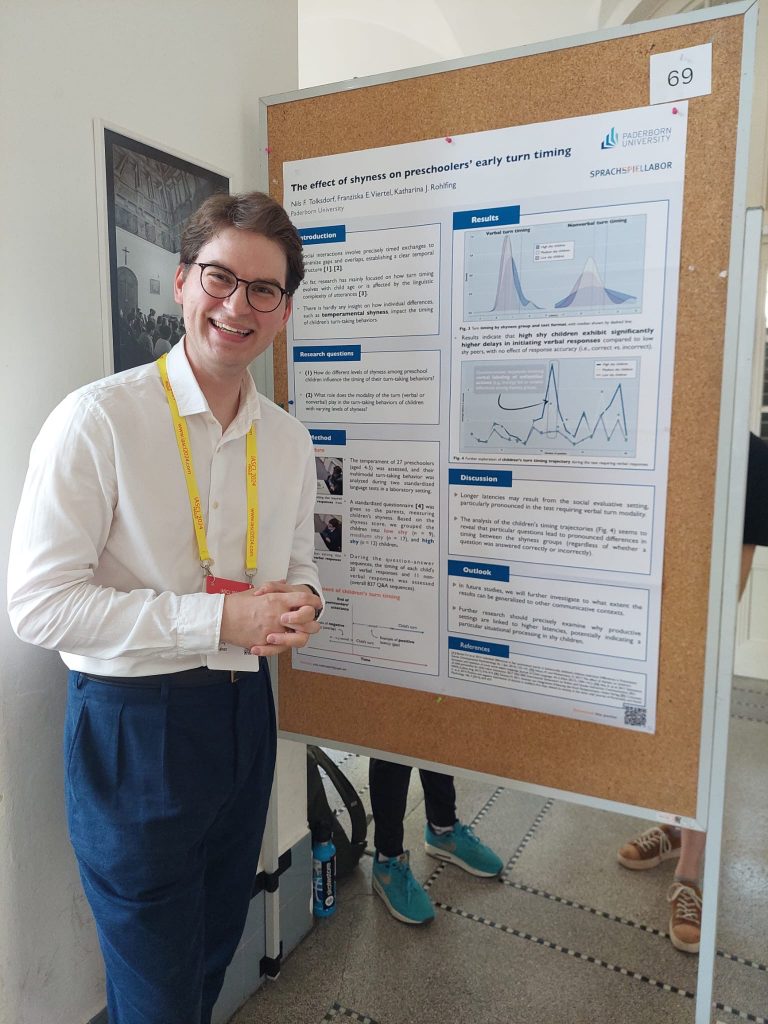
In my research, I examine how temperamental shyness influences children’s communicative behavior and learning in different social contexts and situations. Specifically, I explore how children coordinate and regulate their multimodal responses during interactions. Across assessment contexts, word-learning settings, and child–robot interactions, this work demonstrates that shyness is associated with context-sensitive patterns of multimodal behavior and adaptive processing.
Key aspects of investigation include:
Multimodal communicative behavior: how shyness is expressed in children’s gaze, affective expression, proxemics, timing, and broader patterns of expressive behavior across interactional settings.
Adaptation across situations and over time: how children adjust their communicative behavior as situations become more familiar, including changes in the timing of their communicative contributions (verbal and nonverbal turns).
Learning and assessment under social demands: how shyness influences children’s observable behavior in learning and assessment contexts.
Sensitivity to variation in the social environment: how children differ in their processing of novelty, changes in social and task demands, and socially evaluative contexts, and how this sensitivity is reflected in their communicative behavior.
Related publications
Tykhonenko, V., Tolksdorf, N. F., & Rohlfing, K. J. (2026). The relation between children’s shyness and their contingent dialogical actions when reacting to a social robot’s instructions. Philosophical Transactions B, 381(1943), 20240375. https://doi.org/10.1098/rstb.2024.0375
Viertel, F. E., & Tolksdorf, N. F. (2024). Multimodal Communicative Behaviours in Shy Children in Assessment Situations and Social Evaluative Contexts. In O. Nesrin (Ed.), Contemporary Issues in Early Childhood Education and Care. IntechOpen.
Tolksdorf, N. F., Viertel, F. E., Crawshaw, C. E., & Rohlfing, K. J. (2021). Do shy children keep more distance from a social robot? Exploring shy children’s proxemics with a social robot or a human. Interaction Design and Children, 527–531. https://doi.org/10.1145/3459990.3465181
Tolksdorf, N. F., Viertel, F., Hilton, M., Poole, K. L., & Kucker, S. C. (2022). Diversity in Children’s Temperament: Perspectives on Shyness in Interaction. Proceedings of the Annual Meeting of the Cognitive Science Society, 44, 22–23. https://escholarship.org/uc/item/0h98q2n3
If you are interested in more details about this work for a radio report, Dr. Franziska Viertel and I were interviewed about our research on shyness, a widespread temperamental characteristic, and how it can influence children’s interactive behavior in different contexts.